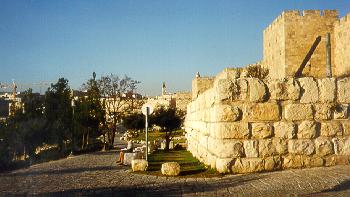
| The city wall is about 4.5 km long, between 5 and 15 m high, and about 3 m thick at its base. Here is a promenade near the western wall. | |
| Damascus Gate (built 1536--1538) is situated in the northern wall. The Arabic name, Bab-el-Amud, refers to a column (amud) that stood nearby. From this column the distances from Jerusalem were measured. | 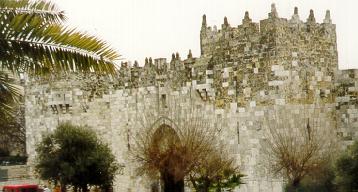 |
| This is Lions' Gate. (But in fact the lions on the walls are not lions but panthers!) Another name is St. Stephen's Gate, because St. Stephen was stoned to death near this gate. (Acts 7:58-60.) | 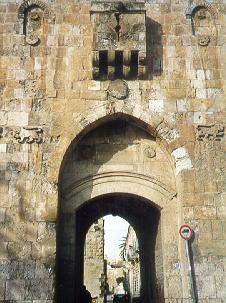 |
| Near Jaffa Gate there is the Citadel. One can see two towers crowning it and both(!) are mistakenly called, the Tower of David. The square tower, though, comes from the Herodian period, while the rounded one is a Turkish Minaret of a Mameluke Mosque of the 17th century. | 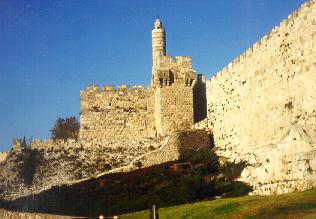 |
| This monument near Jaffa Gate probably refers to Crusaders' invasion, who captured the Holy City from Seljuk Turks. | 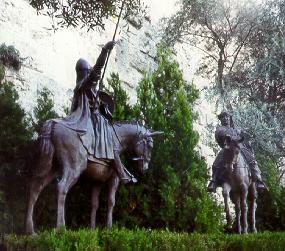 |
| A street in the Old City. | 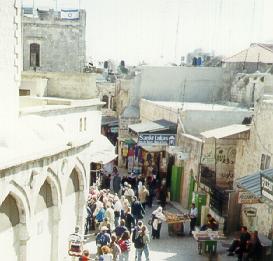 |
| My first few days, I worked at the Institute daytime and paseared evenings. (Later these were swapped.) Jerusalem is very beautiful afterdark, when all the edifices are skilfully illuminated. (Including the Dome of Rock!) Unluckily, I couldn't make any pictures, but here an image from a postcard. Just imagine, how non-trivially the city looks in reality! | 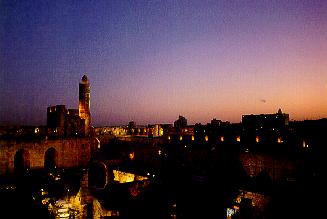 © Palphot |
| In the Armenian Quarter of the Old City there is Christ Church, the first Protestant church in Jerusalem. Its erection was carried out between 1841 and 1849 by the London Society for Promoting Christianity among Jews. The building is laid out in the shape of a cross. | 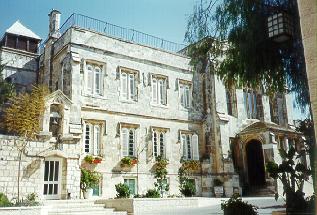 |